Spanish “Cannelloni” Canelones — Veal, Pork, Jamón, and a Whisper of Black Truffle
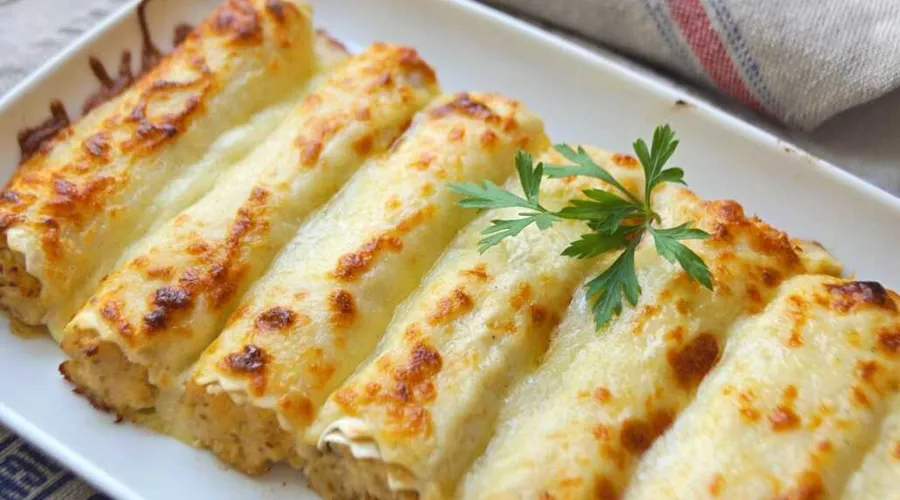
Traditional Catalan canelones — veal, pork, Jamón Serrano, and black truffle, rolled in pasta and finished under a proper béchamel.
Recipe № 004 · Catalan Pasta Bake
Filed · Daily Upkeep kitchen
Spanish canelones — Catalonia's answer to cannelloni, traditionally eaten on Sant Esteve (the day after Christmas) using up the holiday roast. Veal, pork, Jamón Serrano, a shave of black truffle, all rolled in pasta under a proper béchamel.
The recipe is right here. Notes on the Catalan tradition, the truffle (worth it / not worth it), and the swaps that still taste like the real thing live at the bottom.
- Yield 4 ~20 canelones
- Active 1:00 hands-on
- Bake 0:25 at 350°F
- Total 1:30 start to bubbling
- Equipment 9″ dish square baker · two saucepans
Ingredients
-
Pasta
- ~20 Cannelloni pasta squares Flat sheets to roll. Pre-formed tubes work too — see notes.
-
Filling — meat & fat
- 2 tbsp Salted butter For browning the meat.
- ¼ lb Ground veal
- ½ lb Ground pork
- 3 oz Jamón Serrano or prosciutto Finely chopped. Don't substitute deli ham — see notes.
-
Filling — bind & finish
- 1 cup Whole milk
- 1 tbsp All-purpose flour Thickens the filling so it holds in the roll.
- ½ cup Grated parmesan Plus another ¼ cup reserved for the top.
- ½ oz Black truffle Very finely chopped. The traditional Barcelona move — swaps below if you can't get one.
- pinch Salt
- dash Black pepper
- pinch Nutmeg Fresh-grated if you have a whole nut.
- 1 Egg Beaten. Stirred in off-heat, once the filling is cool.
-
Béchamel
- 4 cups Milk Whole milk for the full body; 2% works.
- 5 tbsp Butter
- 4 tbsp All-purpose flour
- ½ tsp Nutmeg
- 2 tsp Kosher salt
Method
-
Pre-heat & set water on
T+0:00Set the oven to 350°F. Put a large pot of water on high to boil — salt it well once it's up.
-
Boil the pasta to al dente
T+0:10Slide the cannelloni squares in one at a time so they don't stick to each other. Cook to al dente, about 12–14 minutes. Drain gently and lay the squares flat, in a single layer, on a clean piece of cheesecloth (or a lightly oiled kitchen towel) to cool. Don't stack — they fuse.
-
Brown the veal and pork
T+0:10Run this in parallel with the pasta. Heat the butter in a large pan on high until it's melted and foamy. Add the ground veal and pork. Break it up and let it brown — push back against the urge to stir constantly; you want color, not steam.
-
Add the jamón, drain the fat
T+0:20Stir in the chopped Jamón Serrano (or prosciutto) and cook another 2–3 minutes, until the edges soften and the rendered ham fat slicks the pan. Tip the pan and drain off the excess fat — there will be a lot. Leave just enough to coat.
-
Build the filling base
T+0:25Sprinkle the flour over the meat and stir for 30 seconds to cook it out. Pour in the milk, scatter the ½ cup of parmesan over the top, and stir until smooth. Add the chopped truffle, the pinch of salt, the dash of pepper, and the pinch of nutmeg. Bring to a low simmer.
-
Simmer the filling
T+0:30Simmer 10–12 minutes, stirring often. You want the mixture to tighten up — not soupy, not dry. When a spoon dragged through the bottom leaves a brief trail, it's there. Pull the pan off the heat and let it cool until it's just warm to the touch.
-
Make the béchamel
T+0:45While the filling cools, build the sauce. Heat the 4 cups of milk in a medium pan over medium until it's almost boiling — bubbles forming at the edges, steam rising. Don't scorch the bottom; pull it the moment you see it tighten. In a second medium saucepan, melt the 5 tbsp butter over medium-low. Add the flour in a slow rain, whisking out lumps as you go, until the roux is smooth. Cook 5–6 minutes, whisking, until it's a light golden color and smells biscuit-like. Pour the hot milk into the roux in a thin, steady stream, whisking rapidly the whole time. Add the nutmeg and salt. Keep whisking until it comes to a boil and thickens to nappé — coats the back of a spoon. Pull off the heat.
-
Egg the filling
T+0:55Once the filling is just warm — not hot, or you'll scramble the egg — stir in the beaten egg. This is what holds the filling together as it bakes.
-
Roll the canelones
T+1:00Divide the filling evenly between the pasta squares — about 2 tablespoons each for 20 canelones. Spoon a line of filling along one edge, then roll the pasta over it into a snug tube. (If you're using pre-formed cannelloni tubes, pipe or spoon the filling in from each end.) Place each roll seam-side down in a 9-inch square baking dish, in a single layer. They should fit shoulder-to-shoulder.
-
Sauce & top
T+1:15Pour the béchamel over the canelones so the rolls are fully covered — corner to corner, no bare pasta exposed (the exposed edges will dry into chips). Scatter the reserved ¼ cup of parmesan over the top.
-
Bake until bubbling and golden
T+1:20Bake 25 minutes, until the sauce is bubbling around the edges and the cheese on top is crisp and deeply golden. If your oven runs cool and the top hasn't browned, flash it under the broiler for 1–2 minutes — watch it like a hawk.
-
Rest, then serve
T+1:45Let the dish rest 5–10 minutes — the béchamel sets enough to scoop cleanly. Serve four or five canelones per plate, with fresh crusty bread on the side.
Notes & swaps
Why this is a Christmas dish in Catalonia
Canelones are the signature dish of Sant Esteve — December 26 — in Catalonia. The tradition started as a frugal one: the leftover roast meats from l'escudella i carn d'olla (the big Christmas Eve stew) get ground up, bound with béchamel, rolled into pasta, and baked. By the late 1800s it had crystallized into the formal version you're cooking here, with the trinity of veal, pork, and Jamón Serrano, and (for the Barcelona-bourgeois version) a shave of black truffle.
You don't need to wait until December. It's a cold-weather Sunday dish that scales up well for a crowd.
On the jamón — don't substitute deli ham
Jamón Serrano is dry-cured Spanish ham — salty, nutty, with a fat that melts into the filling and carries flavor. Prosciutto di Parma is the closest swap and works fine; speck (Alto Adige) also works.
What does not work: deli-counter cooked ham, Black Forest, honey ham. Those are wet-cured, sweet, and turn rubbery when you cook them. If you can only get cooked ham, leave it out entirely and bump the pork to ¾ lb.
The truffle — worth it or not?
A fresh black winter truffle (Tuber melanosporum) costs upwards of $40 per ounce. The traditional Barcelona recipe absolutely uses it; the half-ounce here goes a long way because the fat in the filling carries it everywhere.
If you can't get one — or won't spend it on a weeknight — these swaps come close, ranked best to thinnest:
- 1 tsp truffle paste / truffle salsa stirred in with the milk. The good preserved stuff (look for ingredients: truffle, olive oil, salt — nothing else) is excellent.
- 2 tsp dried porcini powder (grind dried porcini in a spice grinder). Different mushroom flavor, same earthy depth.
- A few drops of truffle oil at the end. Polarizing — many truffle oils are synthetic 2,4-dithiapentane. If yours smells like a panini chain, skip it.
- Just leave it out. The filling is still rich, layered, and good. Don't fake it with shortcut truffle products you don't trust.
Pasta sheets vs. pre-formed tubes
Flat squares you roll are traditional and what Spanish supermarkets sell as placas de canelones. Outside of Spain, look in the dried pasta aisle for "fresh egg lasagne sheets" cut to roughly 5×7 inches, or buy lasagna sheets and cut them down.
Italian-style pre-formed cannelloni tubes are the easy substitute. Same cook time, easier to stuff (pipe the filling in with a piping bag, or push it in from each end with a small spoon). The texture is slightly different — the rolled version has a thinner seam that crisps under the cheese.
Spinach and ricotta variation
The filling format is forgiving. A common worldwide swap: 1 lb fresh spinach (wilted, squeezed dry, chopped), 15 oz whole-milk ricotta, ½ cup grated parmesan, 1 egg, salt, pepper, nutmeg. Skip the meat-browning step entirely — combine everything in a bowl, fill, roll, sauce, bake. Same béchamel, same 25 minutes.
Béchamel rules
- Hot milk into cooked roux. Not cold. The temperature gap is what makes lumps. Heating the milk first is non-negotiable.
- Cook the roux long enough. 5–6 minutes to light gold. Undercooked roux tastes like flour paste — you can't fix it later.
- Pour in a thin stream, whisk constantly. The first cup of milk is the high-stakes one. Once that's smooth, the rest goes in easily.
- Salt at the end. Easier to season correctly once it's the right consistency.
Make-ahead & storage
- Assemble ahead: Roll the canelones, sauce them with béchamel, top with cheese, cover, and refrigerate up to 24 hours. Bake straight from the fridge — add 10 minutes to the bake time.
- Fridge: 3 days after baking, covered. Reheat covered at 325°F for 20 minutes.
- Freezer: Freeze before baking, well-wrapped. 2 months. Thaw overnight in the fridge, then bake as written + 10 minutes.
- Don't freeze leftovers after baking — the béchamel separates and the texture gets grainy.
What to serve with it
Fresh crusty bread for the béchamel that escapes the dish. A green salad with sharp vinaigrette — escarole, frisée, or arugula with sherry vinegar — to cut the richness. A glass of Garnacha, Tempranillo, or any dry red you'd drink with a roast.
If you're making a full Catalan night of it, start with pa amb tomàquet (toasted bread rubbed with garlic and ripe tomato) and finish with butterbeer cookies — not Catalan, but they sit on the same comfort spectrum. Or page through the rest of the kitchen archive for what comes after a snowy December.
Discussion for this post
Letters, marginalia, and dispatches from fellow readers.
Likes, favorites, and comments are available for signed-in readers.
Comments
Be the first to drop a thought.