Captain's Log · Chronicle of a Voyage
My One Piece Journey — A Timeline Journal
From Romance Dawn to the Summit War — what I felt, what hit, what surprised me.
This page grows with the watch. Each dot above is an arc I’ve finished. Click any dot to read the entry — or scrub the timeline to see how far I’ve come.
Chapter № I
Romance Dawn
Where it all begins — a boy in a straw hat and a borrowed promise.
What stuck with me
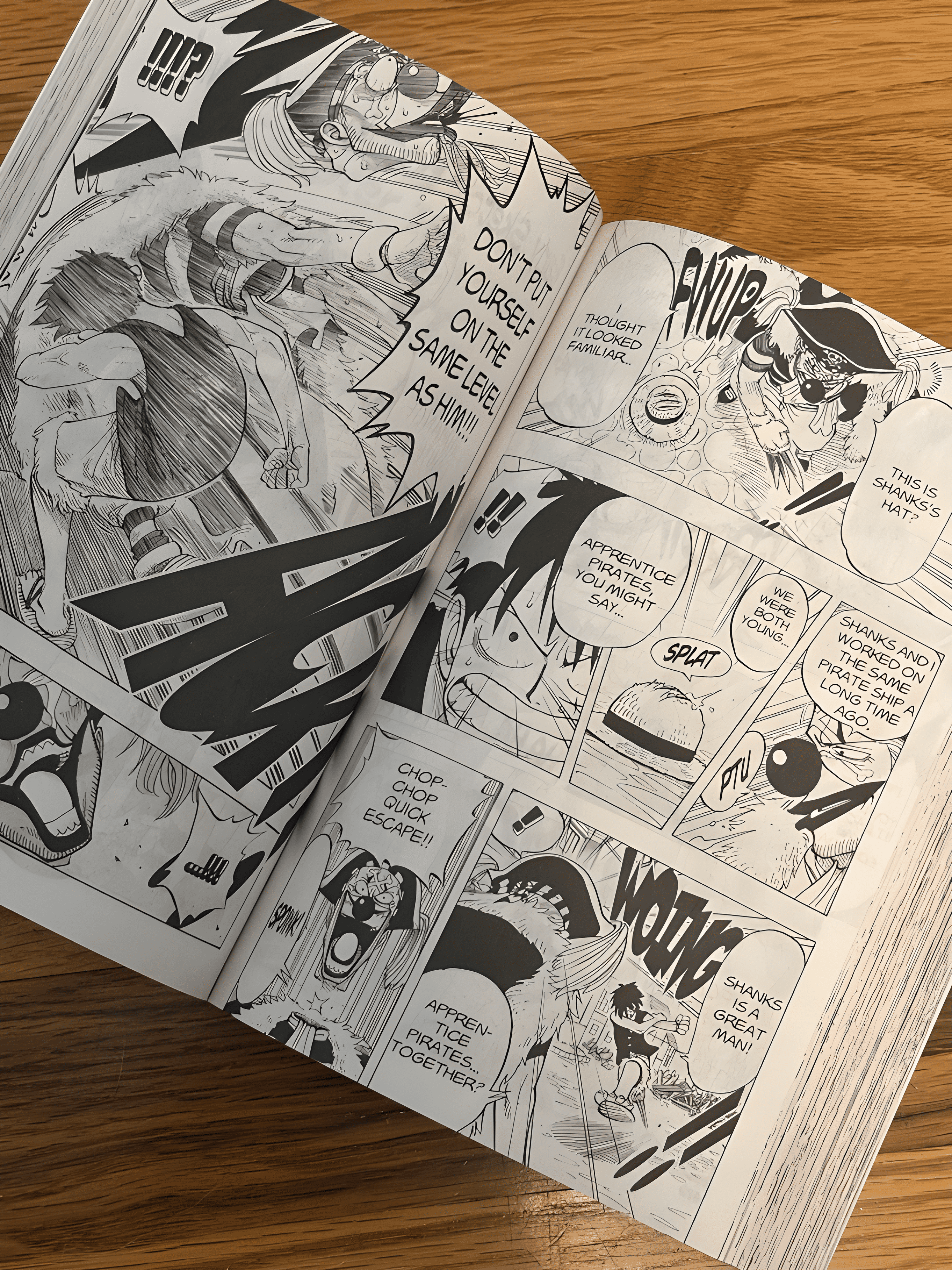
Romance Dawn is such a solid base. I love how it sets up Luffy instantly — the rash, annoying side mixed with the confidence, the power, the absolute passion. You meet the whole guy in thirty minutes.
What sticks with me from this arc: Shanks losing his arm, and the introduction of Zoro with the defeat of Axe-Hand Morgan close behind.
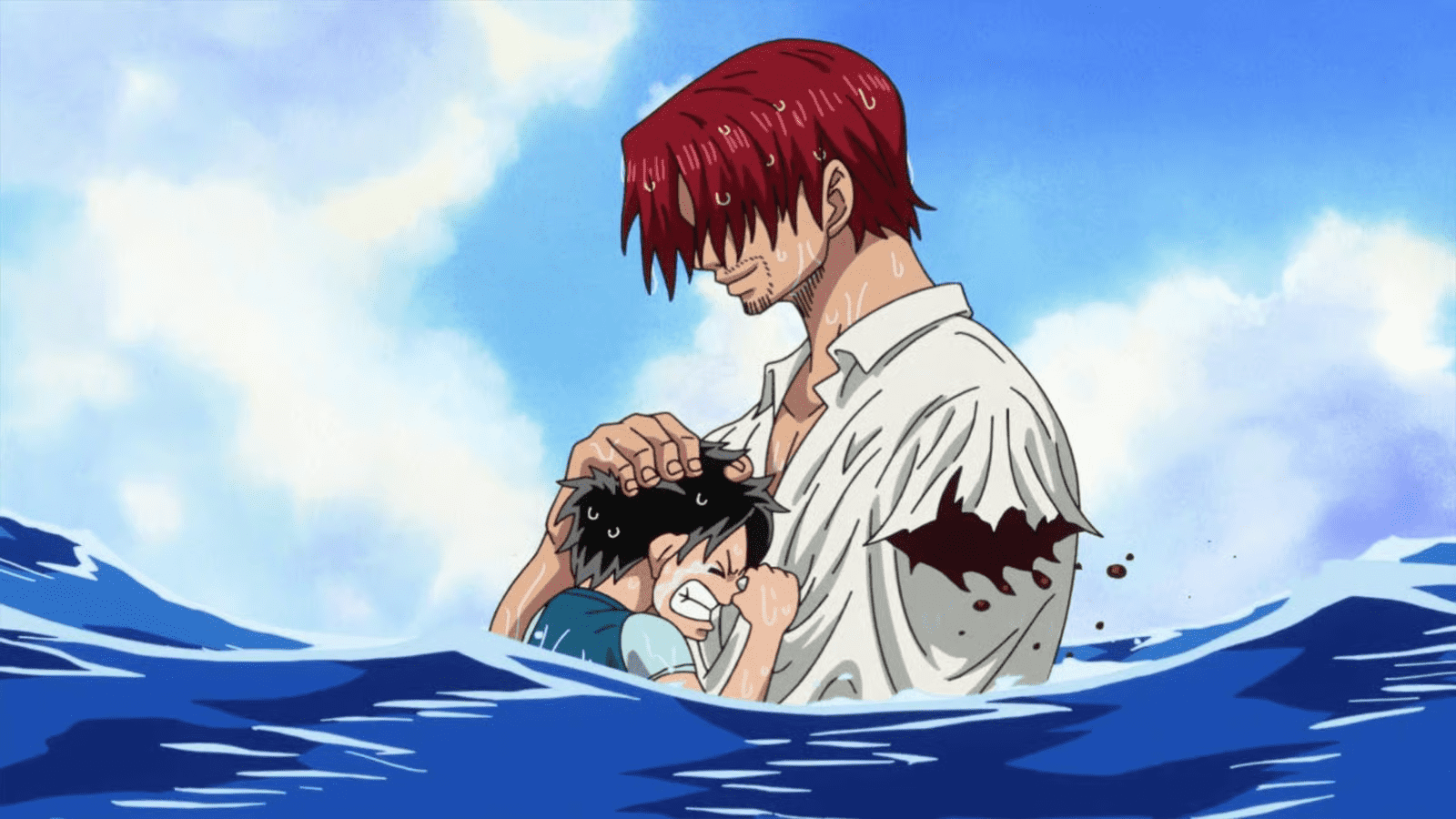
First watch — around 2022, right before the live action
I first watched Romance Dawn around 2022, right before the Netflix live action came out. I made it to the Baratie arc before I switched over to the live action and never looked back at the anime.
Honest take from back then: One Piece felt slow. The 1000+ episode count probably didn’t help — every time I sat down to watch I could feel the long road ahead. It was charming, but I wasn’t hooked yet.
The manga — Volume 1, early 2026
Once I got hooked (more on that in later arcs), I started buying the manga.
Volume 1 was the first one I picked up at the beginning of 2026. If you’re thinking about doing the same, I wrote up which Viz box set to buy first — short answer, it’s Box Set 1, which kicks off right here in Romance Dawn.
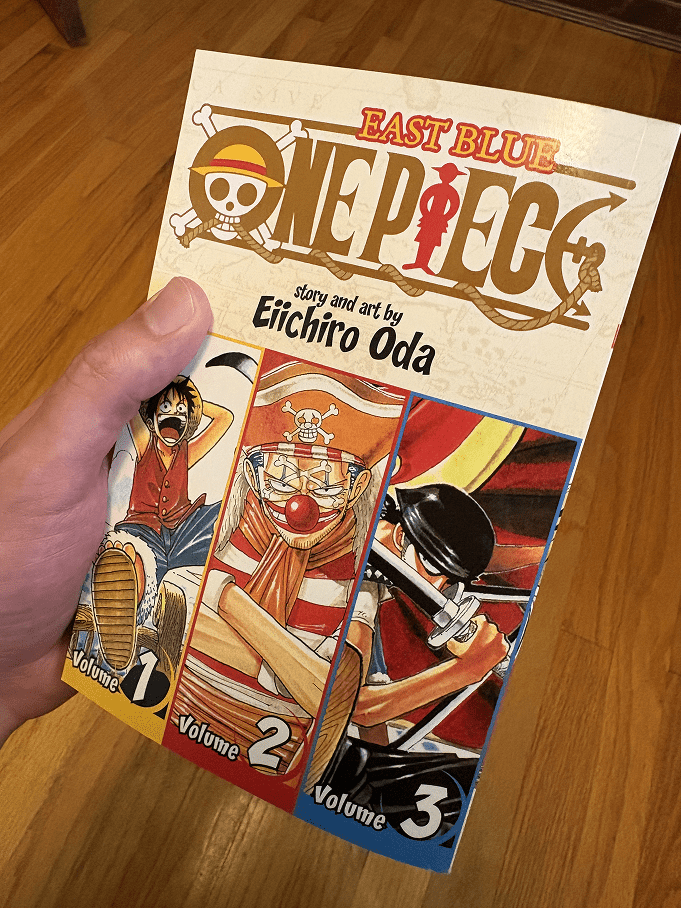
Reading the manga after watching Marineford is wild. Oda’s pacing on the page is much tighter than the anime, and Romance Dawn lands harder when it’s not stretched across multiple episodes.
The anime — rewatching on Netflix, 2026
I started rewatching the anime on Netflix this year, now that I’m past Marineford.
And here’s the wild part: Romance Dawn has a completely different meaning to me now. It sets up literally everything without giving anything away. Shanks. The straw hat. The promise. Watching it after the Summit War, every offhand line lands like a gut-punch.
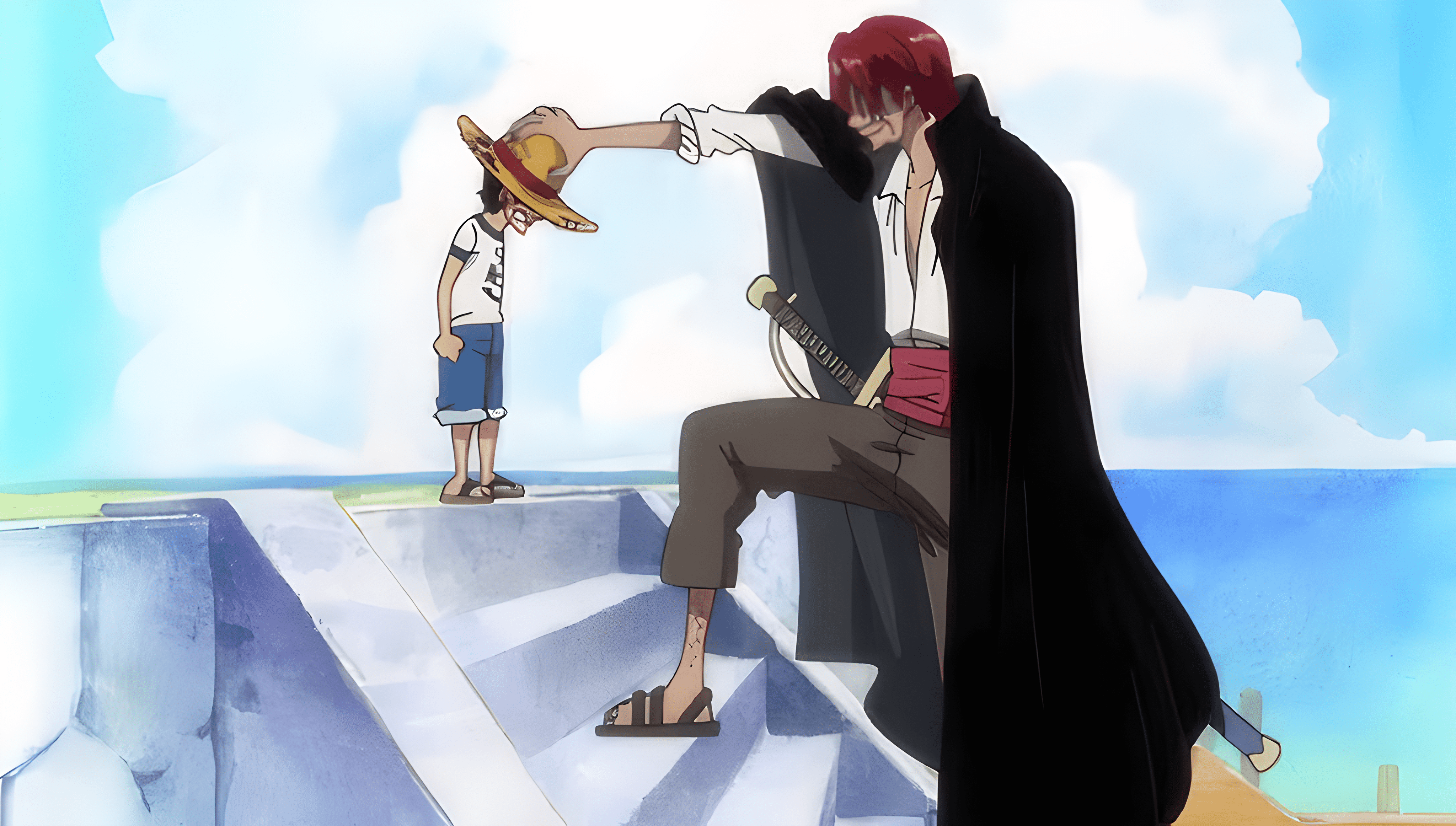
If you’re new to One Piece, this arc is charming. If you’ve watched Marineford, this arc is a will.
Chapter № II
Orange Town
Buggy the Clown, the introduction of Nami, and the first taste of Oda's patience.
What stuck with me
Orange Town doesn’t carry a single image that lands like Shanks’s arm. But two things matter here: we meet Nami, and we meet Buggy.
The further I get into One Piece, the more I appreciate these early arcs. Oda has this gift for not making anything feel too easy and not making anything feel impossibly hard — every fight lives in exactly the right gap, and you can always feel that the crew has more room to grow. The runway is built into every chapter.
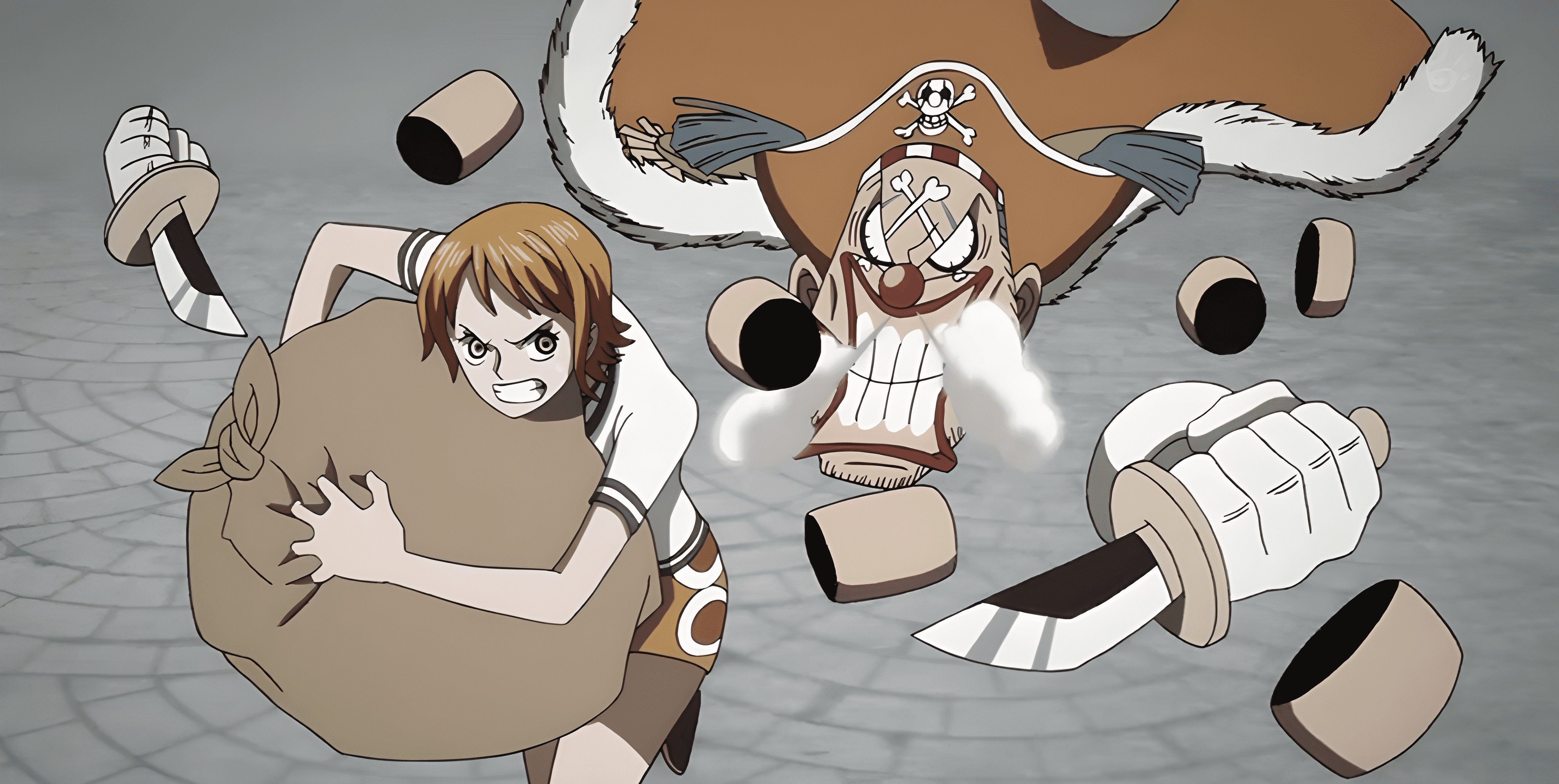
First watch — 2022, right after Romance Dawn
This was part of my original 2022 watch, alongside Romance Dawn. Vibe-wise it felt very similar — charming, episodic, easy to put down.
Buggy on first watch? He was fine. A theatrical clown villain for Luffy to punch.
I think very differently now.
The manga — Volume 2, early 2026
I picked up Volume 2 this year alongside Volume 1. Honestly it hits just like the anime — but it’s a fresh way to revisit the start of the journey without sitting through a full slate of episodes.
If anything, the manga sets Buggy up better than the anime does. He reads goofier on the page from the very first panel — Oda’s pencil makes the slapstick feel inherent rather than performed.
The anime — Netflix rewatch, 2026
Same Netflix path as Romance Dawn. The live action interpretation of this arc is enjoyable too — though I’d still give the manga the edge for how it introduces Buggy.
The real change is this: now that I’ve seen Buggy later in the story, I love him. Watching his debut after seeing what becomes of him is its own kind of fun. He’s a guy who failed upward into one of the most powerful pirates in the world, and Orange Town is patient zero.
Buggy is a great starting villain. He sets the baseline. Later, when you watch Luffy take on the Warlords, the Admirals, the Emperors — you remember when the threshold was this guy with detachable feet on a tiny spring island. The contrast tells the whole story.
Chapter № III
Syrup Village
Usopp earns his place — and the crew gets the Going Merry.
What stuck with me
Syrup Village is the first arc that feels like a rounded story. Romance Dawn is setup and Orange Town is a vignette, but Syrup Village has a beginning, a middle, and an end that all land. There’s a real village, a real villain with a real plan, and a kid whose lies finally have to become something true.
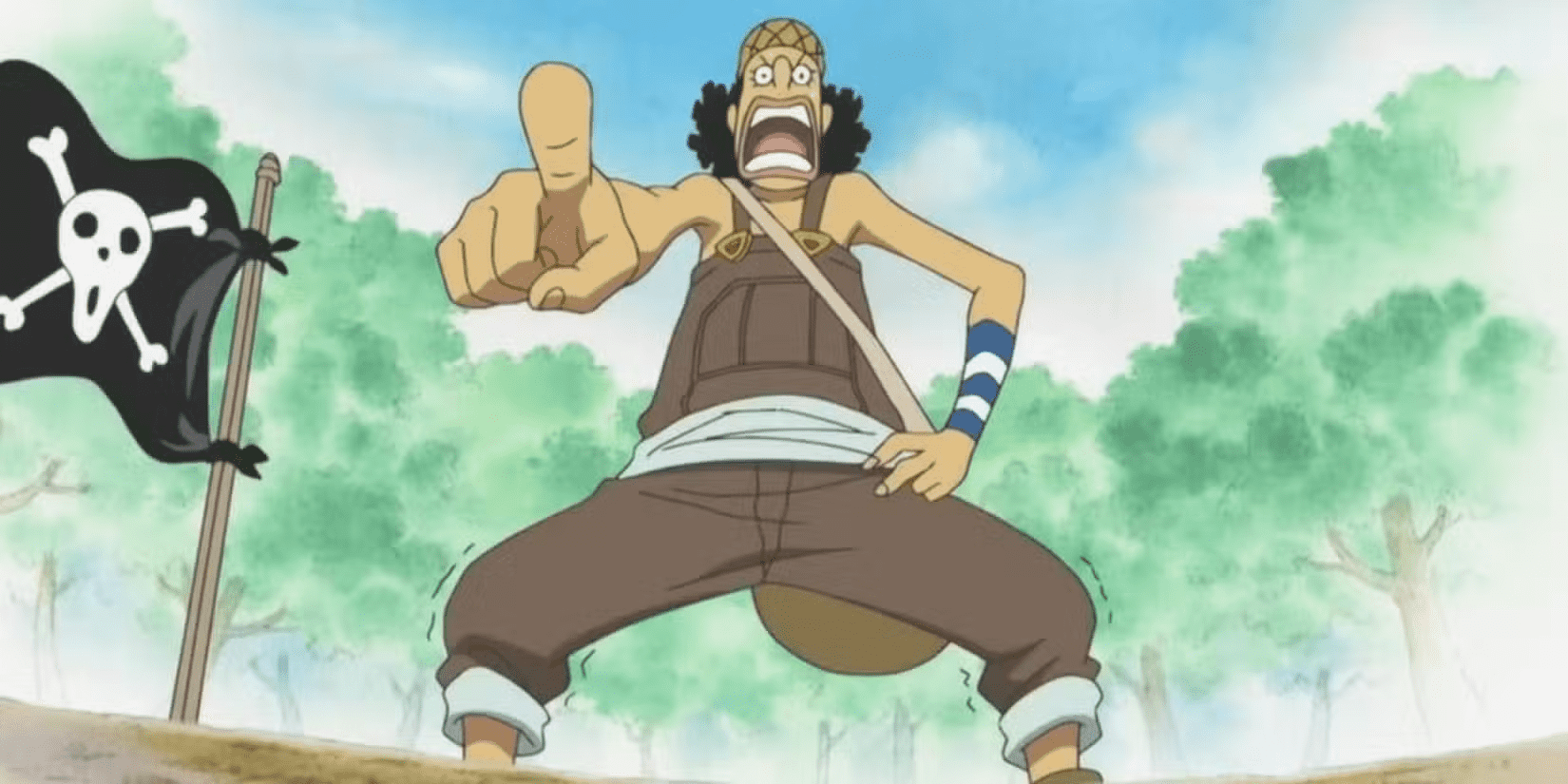
Two things stick with me here: Usopp joining the crew, and the crew getting the Going Merry. Either one alone would make this arc matter. Together they turn the Straw Hats from “Luffy and Zoro plus a thief who keeps almost leaving” into an actual ship with an actual sniper.
First watch — 2022
I loved Syrup Village on the first watch and I still love it now. Some of the early arcs felt slow to me in 2022 — Romance Dawn and Orange Town both had that “I can feel the 1000 episodes ahead of me” weight. Syrup Village didn’t. The pacing tightened, the stakes were clearer, and Usopp was instantly the kind of character I wanted on the ship.
Kuro is also doing a lot of work here. A villain who has spent three years undercover as a butler, planning a fake bandit raid to murder the girl he’s been serving tea to — that’s not a chop-chop clown gag. That’s the first time One Piece showed me it could write a real heel.
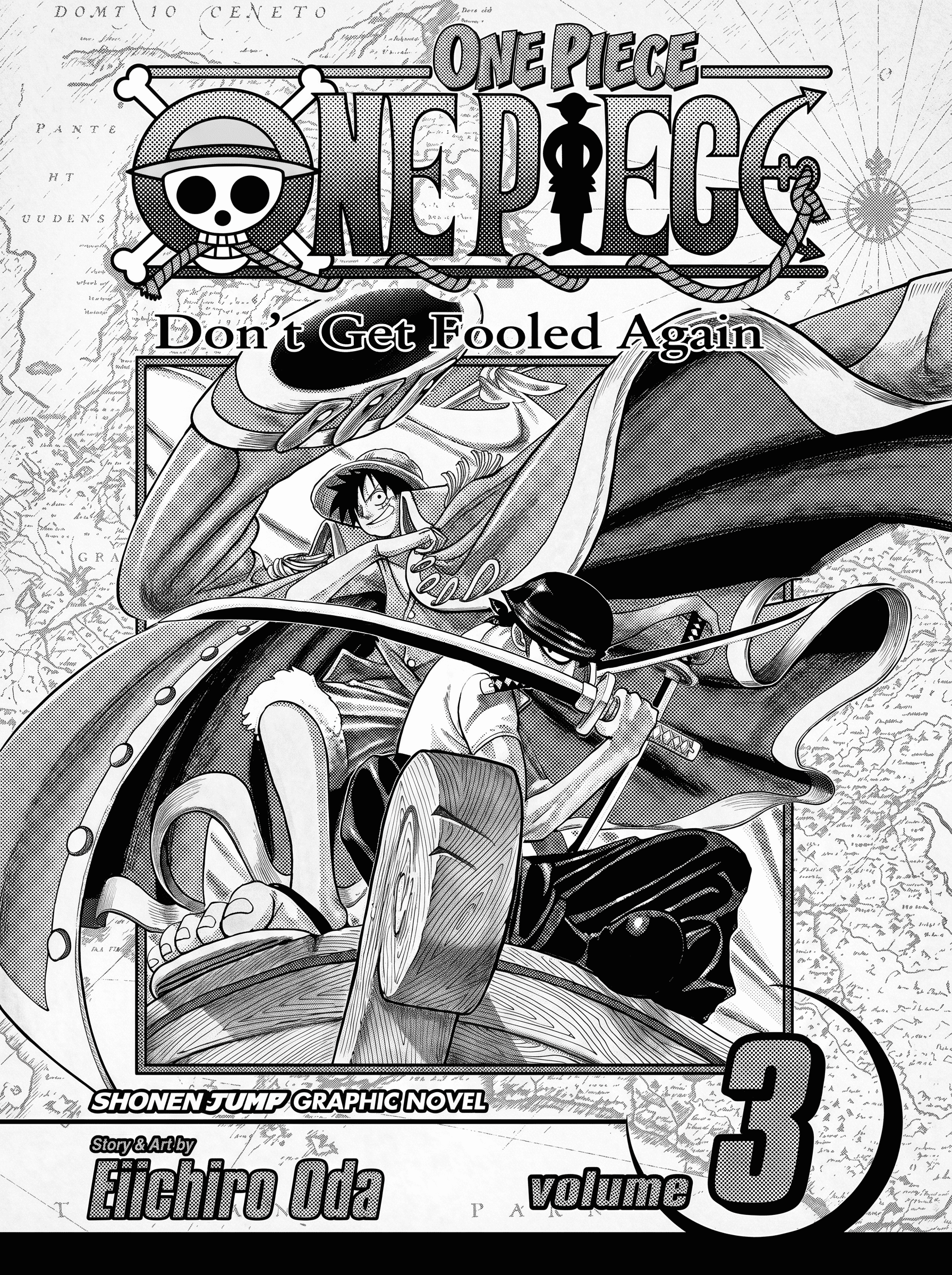
The manga — Volume 3, early 2026
I picked up Volume 3 alongside the rest of Box Set 1 at the start of 2026.
On the page, the Usopp Pirates land even harder. Onion, Carrot, and Pepper running through the village screaming about pirates every morning — it reads like the joke it is, but Oda also lets you feel the loneliness underneath it. Usopp tells lies because the truth (his mother is dead, his father is gone, the village writes him off) is unbearable. The manga makes that subtext text in a way the anime stretches thin.
The anime — Netflix rewatch, 2026
Same Netflix path as the earlier arcs. The rewatch is where Syrup Village really opens up for me.
Knowing what the Going Merry becomes — knowing what Water 7 does to it — turns Kaya’s gift into one of the saddest happy moments in the whole series. She hands them a ship she had built with love, and you already know how the story ends for it. The crew doesn’t know yet. They’re just excited to have a real boat.
That’s the whole trick of rewatching One Piece. Every gift is also a goodbye you can already see coming.
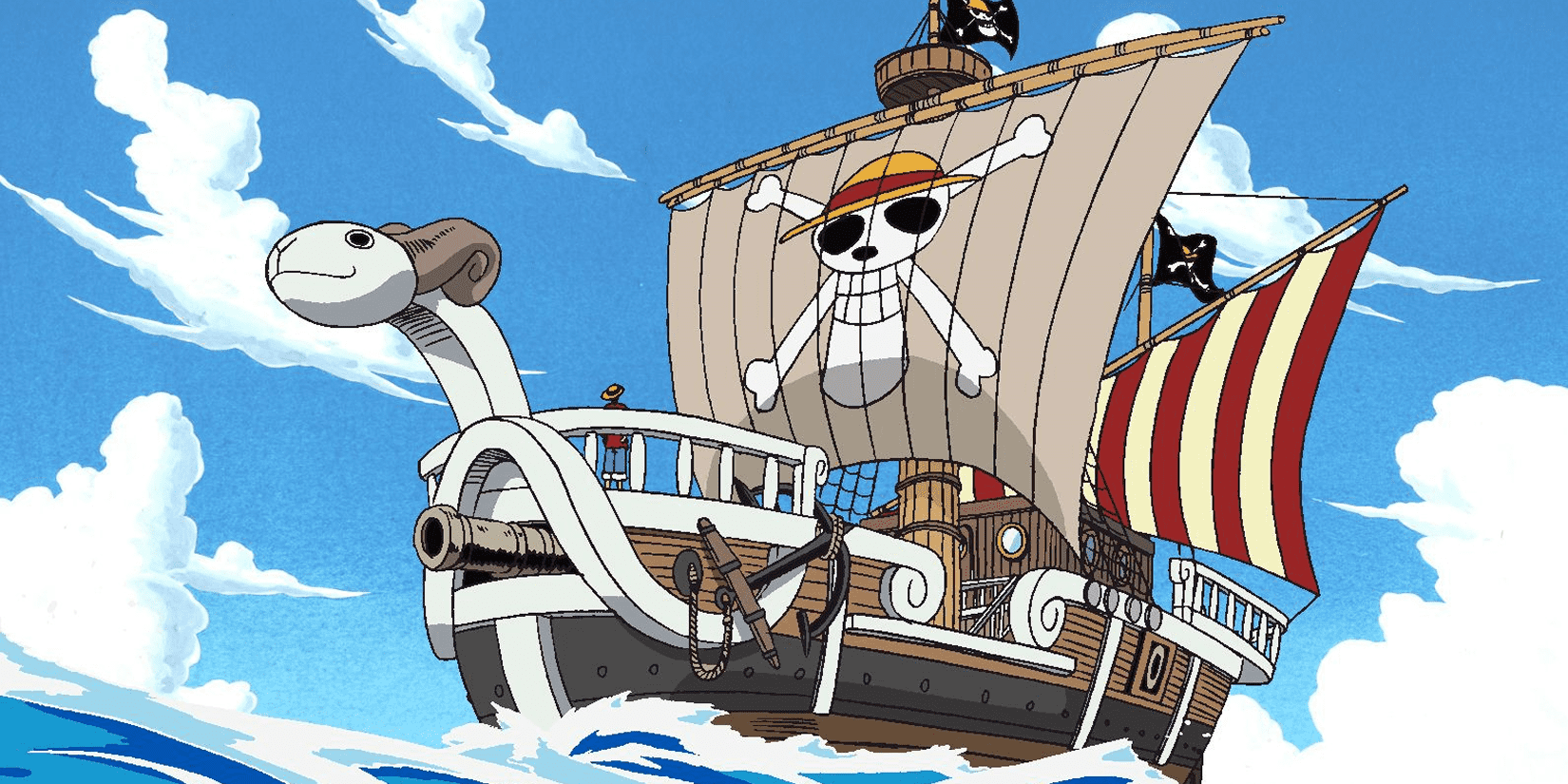
And Usopp — Usopp on the slope, alone, lying about pirates until pirates actually come and he has to be the thing he pretended to be — that’s the arc. The lie becomes the truth. The sniper takes his seat. The crew is four.
Chapter № IV
Baratie
Sanji's debut, Zeff's leg, and the first appearance of Dracule Mihawk.
What stuck with me
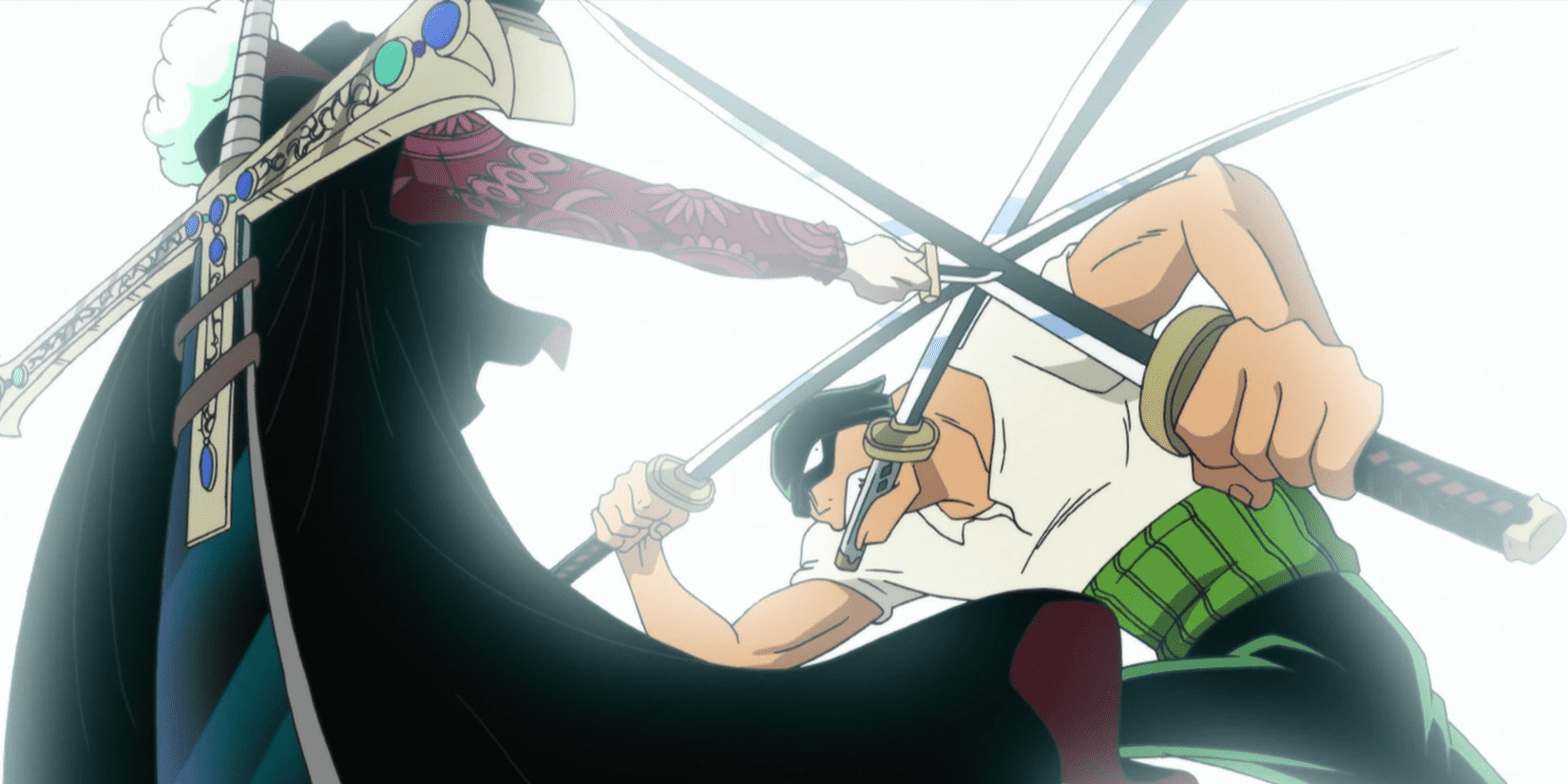
Baratie is where One Piece stops auditioning and starts performing. Two things lock in for me here: Mihawk vs Zoro, and Sanji’s debut alongside Zeff’s backstory. Either one would carry the arc. Together they push the ceiling of the whole series up a floor.
Mihawk is the moment Zoro stops being the strongest fighter in the room. He gets cut open by a man holding a tiny knife, then a real sword, then he turns around and takes the killing blow on his chest because he refuses to die with a scar on his back. “Nothing happened” is one of the cleanest character beats in the early manga. The world just got bigger, and the goal just got specific.
First watch — 2022
Loved Baratie on the first watch and I still love it now. After Syrup Village it was the second arc in a row where I felt the series actually grabbing me. Sanji is instantly the kind of character that fills a role nothing else can — the chivalrous, smoking, kicking cook who would rather die than waste food. He doesn’t overlap with Luffy or Zoro at all.
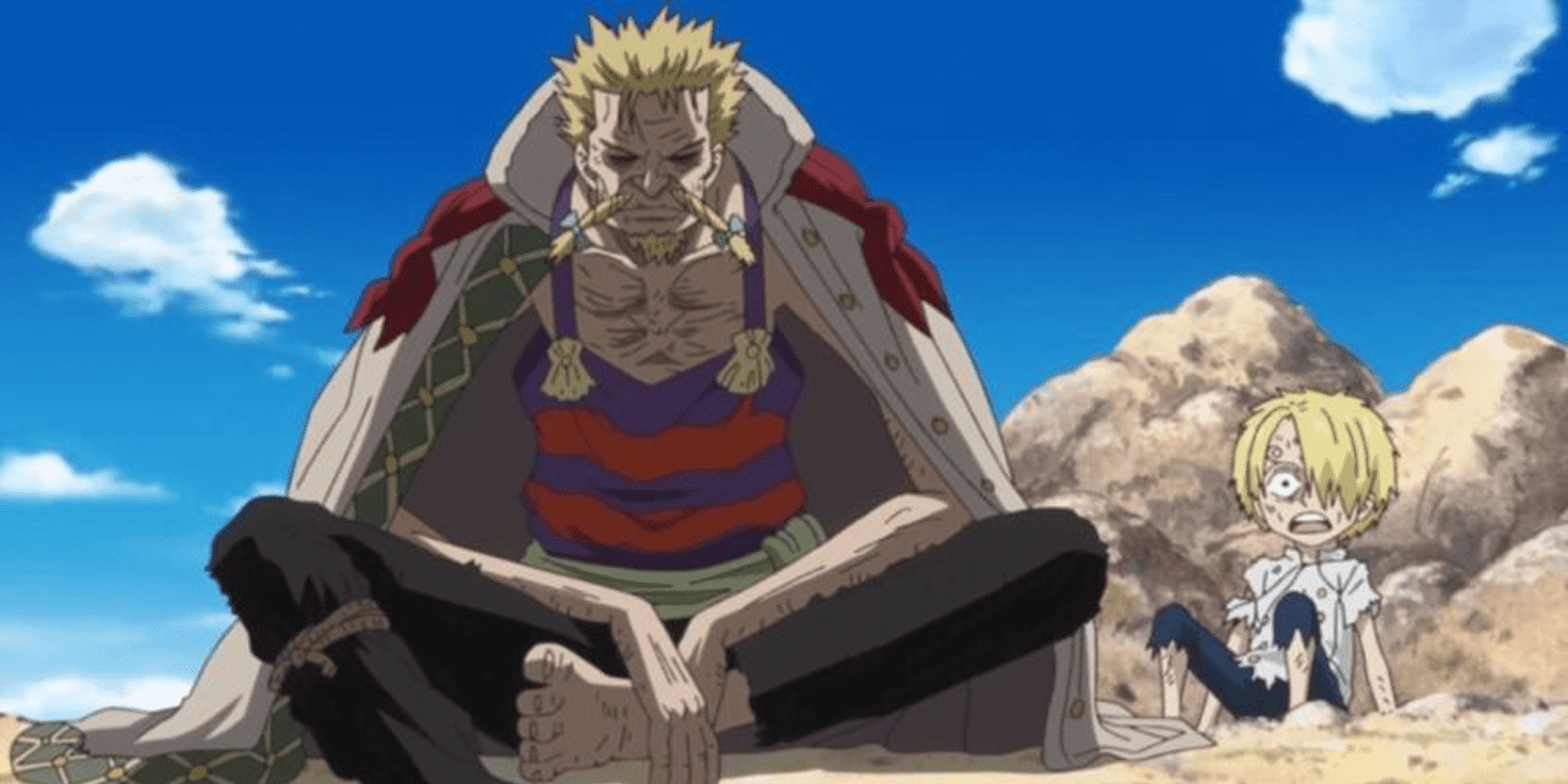
And Zeff is the secret weapon of this arc. The backstory — the leg, the food, the eighty-five days on the rock — recontextualizes every gruff thing he says to Sanji. The dream of All Blue isn’t a goofy fishing fantasy. It’s a debt being paid.
The manga — early 2026
Baratie sits inside Box Set 1, and Oda’s pacing on the page is where the Mihawk scene really earns its weight. The anime stretches the duel across episodes; the manga gives it the silence it needs. A few panels, no dialogue, a sword the size of a door.
The Sanji/Zeff flashback hits harder on the page too. Manga is good at letting a single image do a paragraph of work, and the leg reveal is one of those panels.
The anime — Netflix rewatch, 2026
Same Netflix rewatch path. Knowing where Zoro ends up — knowing what it means when he says he won’t lose again — makes the Mihawk scene feel like a starting gun rather than a beating. Every Zoro fight after this one is a payment toward the promise made on this deck.
Sanji on rewatch is also funnier. Once you’ve seen a thousand episodes of him short-circuiting around women, the original “ladies don’t pay” beat plays like an origin myth instead of a gag.
The crew is five. The strongest swordsman in the world has a name. The compass starts pointing at the Grand Line.
Chapter № V
Arlong Park
Nami's backstory — the arc that decides whether you stay with One Piece forever.
What stuck with me
Arlong Park is the arc. If Syrup Village is the first rounded story and Baratie is the first arc to push the ceiling, Arlong Park is the first arc that breaks you. Three things stick with me, and they’re really one thing told in three pieces: Nami’s backstory and Bell-mère, “Luffy, help me,” and Luffy vs Arlong tearing the building down.
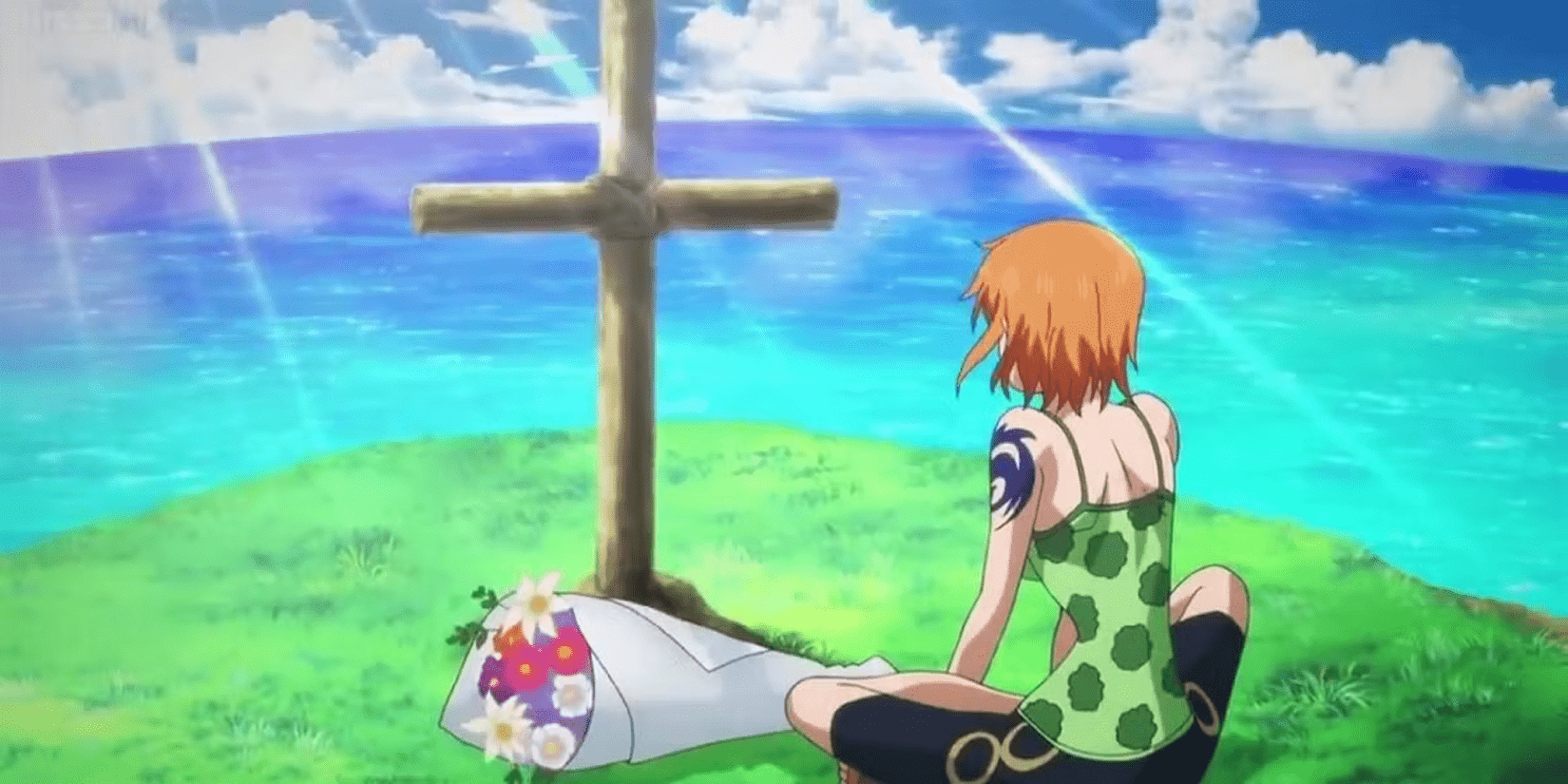
Bell-mère is the engine. A marine who quits to raise two girls she found in a war zone, who eats tangerines so the girls can eat real food, who chooses to die in front of her daughters rather than disown them — that’s a complete novel inside one chapter. The tangerine grove and the tattoo aren’t symbols. They’re the proof of who Nami actually belongs to.
“Luffy, help me”
This is the line. Nami has spent two arcs lying, stealing, leaving, coming back, and trying to do it all alone because she thinks she has to. Then the map breaks, the knife comes out, the arm she’s been tattooed with starts bleeding, and she finally — finally — asks.
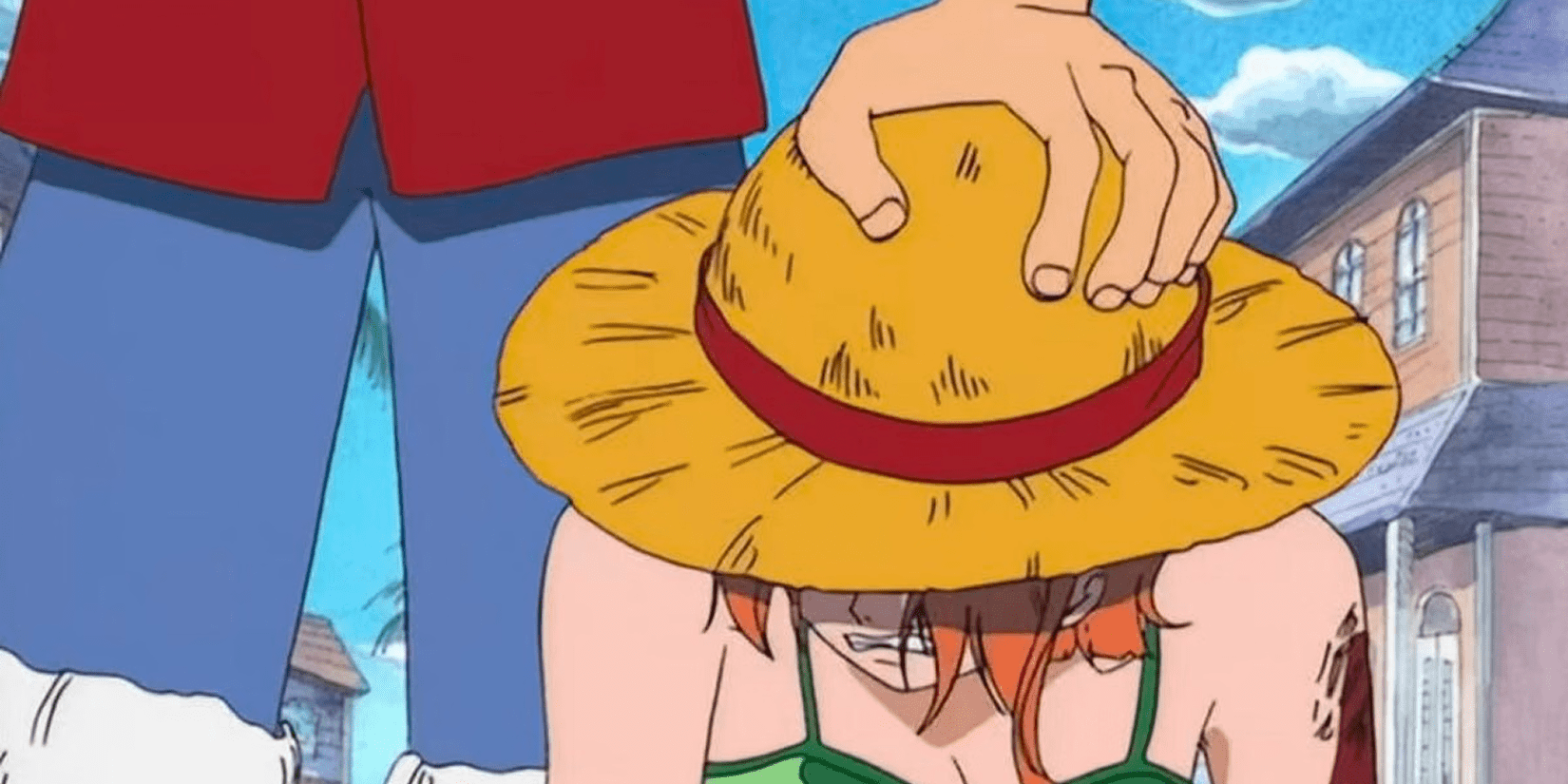
Luffy doesn’t speak. He walks over. He puts the straw hat on her head.
That’s the moment One Piece stops being a fun pirate cartoon and becomes a story I will follow for a thousand episodes. The hat is the most valuable thing he owns. It is a promise from Shanks. He puts it on her without a word because she is his now, and the crew goes to work.
Luffy vs Arlong
The fight itself is great, but what I remember is the architecture. Luffy doesn’t just beat Arlong. He destroys the building Arlong built on top of Nami’s village. The map room — every chart Nami was forced to draw for eight years — goes down with it. Punching the structure into the sea is the catharsis the arc has been earning since Bell-mère’s gunshot.
“I’m Nami’s nakama” is the cleanest mission statement Luffy ever gives. No speech. No philosophy. Just a relationship and a fist.
The manga — Volumes 8–11, early 2026
I read this run early in 2026 as part of working through Box Set 1 and into Box Set 2. On the page, the Bell-mère flashback is even more devastating — Oda gives it the space and silence that the anime occasionally fills with score. The tattoo reveal lands like a body blow.
This is also the first arc where I caught myself reading slower on purpose. I knew what was coming and I didn’t want to rush it.
The anime — Netflix rewatch, 2026
On the rewatch, Arlong Park hits differently because I now know how much of the rest of the series is downstream of this arc. Every time Nami trusts the crew with something, every time she calls in a favor from Luffy, every time she chooses the Going Merry over a safer path — it traces back to a hat being placed on her head by a boy who didn’t need to be asked twice.
This is the arc that decides whether you stay with One Piece forever. I stayed.
Chapter № VI
Loguetown
Where the Pirate King was born, where the Pirate King died — and where Smoker enters.
What stuck with me
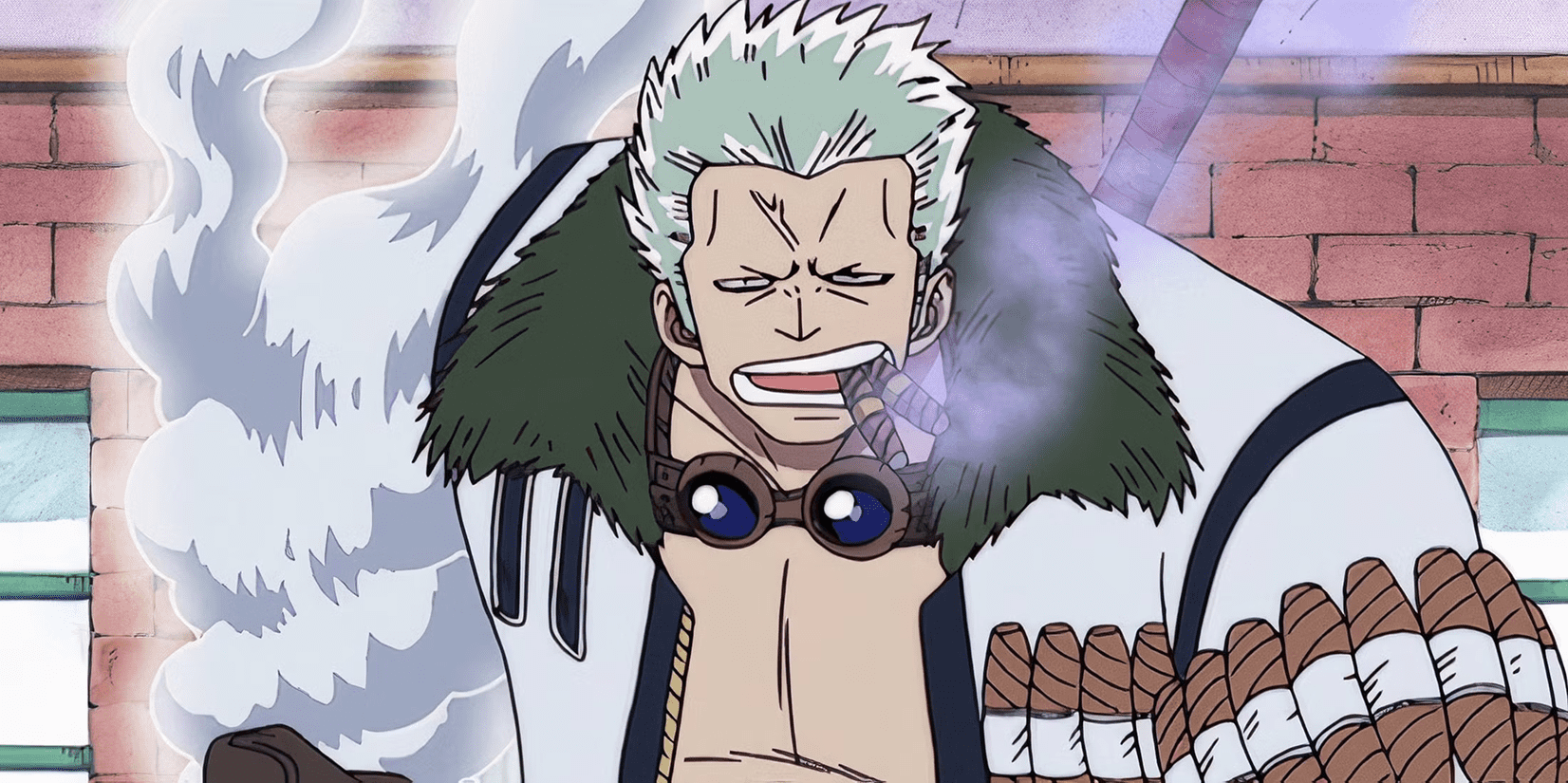
Loguetown is short, but it’s where East Blue stops being a kid’s adventure and starts being a pirate story with weight. Two things lock in here: Smoker’s debut, and Buggy’s execution platform.
Smoker is the first marine who reads like a real obstacle. Logia, white smoke pouring off his coat, jutte across his back, and a worldview — “Justice will always prevail” — that isn’t cartoon evil. He’s a man who genuinely believes in what he’s doing. After three arcs of Marine 77 redshirts, a Logia smoking a cigar with a kid’s playing-card grin is a different kind of villain to face. The fact that he respects Luffy and still tries to put him down is the whole tension of Marines vs Pirates in one character.
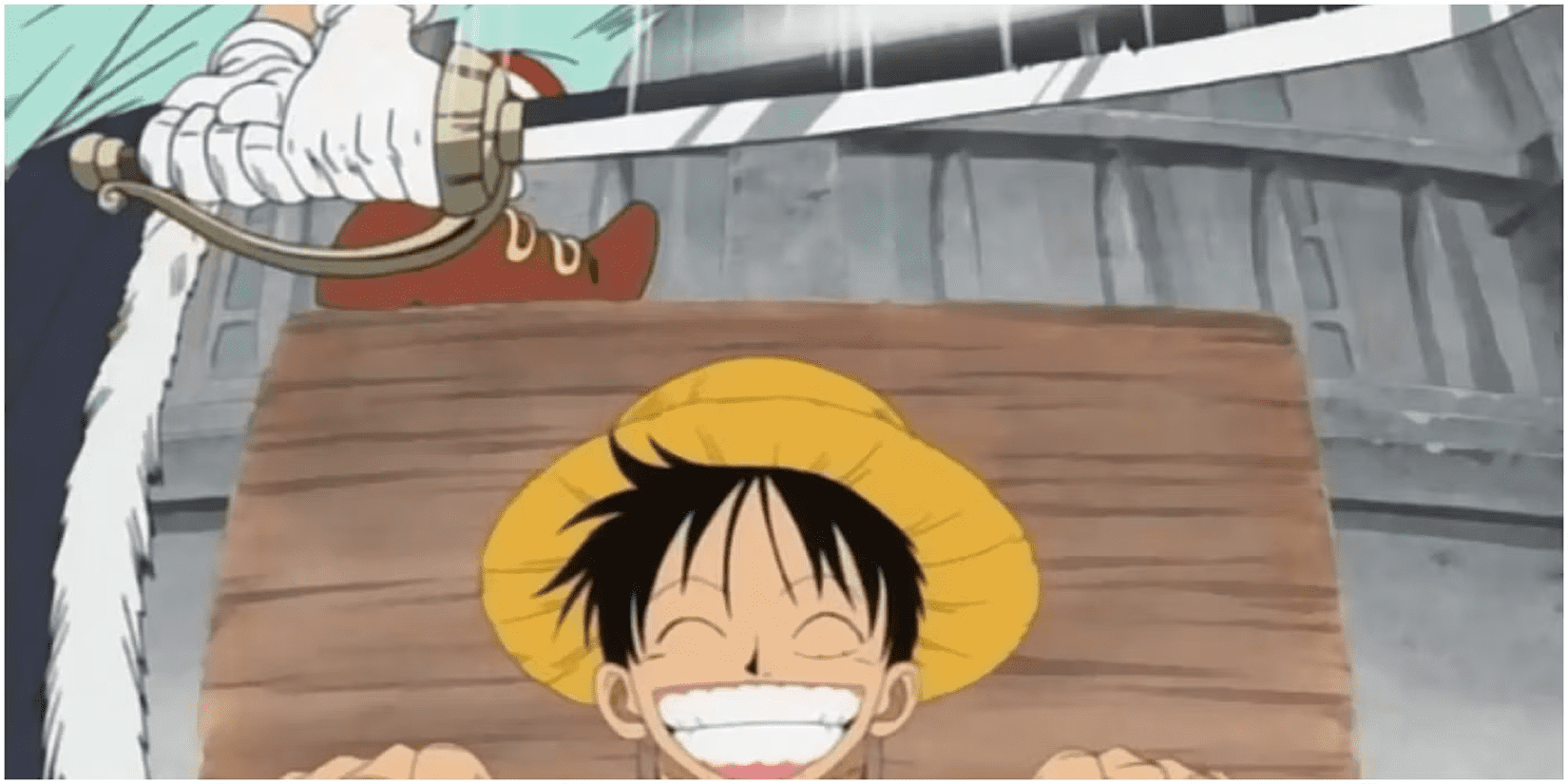
The execution platform
The Roger callback is the moment. Luffy climbs up onto the same scaffold where the King of the Pirates was executed, looks out at the same crowd, and laughs — and then Buggy drops the blade. For a beat the show is telling you Luffy might actually die in episode fifty-something.
The lightning strike is the cleanest “Oda playing with destiny” moment in early One Piece. The Pirate King laughed. The next one laughs too. The sky agrees.
First watch — 2026
Loguetown is past where my original 2022 anime watch ever made it — I bailed during Baratie and went to the live action. So my first time seeing this arc was on Netflix in 2026, after I’d already gotten through Marineford and come back to fill in the East Blue I’d skipped.
That’s a weird way to meet Loguetown. I already knew what the Roger callback meant before I watched it. I already knew who Smoker becomes. So this arc didn’t have any chance to feel like a setup — it felt like a payoff for a story I’d already finished.
Loved it anyway. Loguetown is East Blue’s chapter break: Zoro picks up new swords, Sanji buys ingredients, Nami buys clothes, Luffy eats. Then the storm rolls in and the Grand Line opens.
The manga — Volumes 11–12, early 2026
I read Loguetown alongside the Arlong fallout in the back half of Box Set 1 / start of Box Set 2. The manga compresses the Smoker chase brilliantly — on the page it’s tighter, more claustrophobic, and the execution platform beat lands in fewer panels than the anime gives it. Faster, but somehow more.
The lightning strike hit different on the page. The crew sets sail. The compass points up. East Blue is closed.
Chapter № VII
Whisky Peak & Little Garden
Vivi joins the journey, Mr. 3 sets a trap, and two giants fight forever.
What stuck with me
This is the arc where One Piece stops being a sea story and becomes a Grand Line story. The scale changes. The rules change. Four things stick with me: Laboon, entering the Grand Line, Zoro vs the 100 bounty hunters at Whisky Peak, and Dorry and Brogy’s 100-year duel.
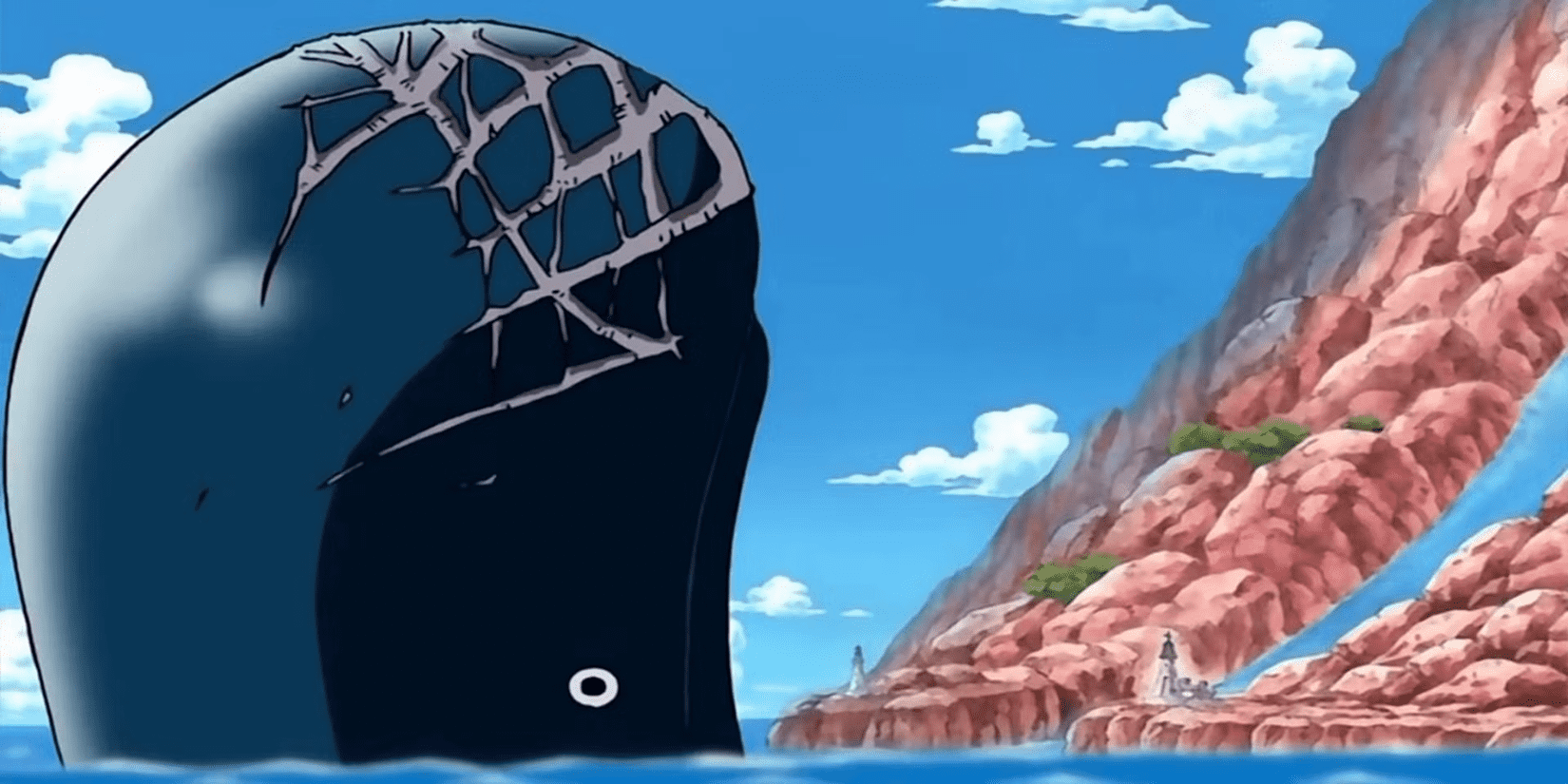
Laboon is the tone-setter for everything that follows. A whale the size of an island slamming his head against the Red Line because he’s waiting for a crew that will never come back — that’s the entire emotional thesis of One Piece in one image. The promise outlasts the people. Luffy paints the flag on Laboon’s head and the rest of the series is a footnote to that scene.
Entering the Grand Line
Crocus, the lighthouse, the magnetism explanation, the climb up Reverse Mountain — Oda spends a real chunk of pages making sure you feel that this ocean isn’t the same ocean. Four currents crash into one and the Going Merry shoots into the sky. The crew of East Blue is gone. Whatever they are now, they are something else.
Zoro vs the 100 bounty hunters
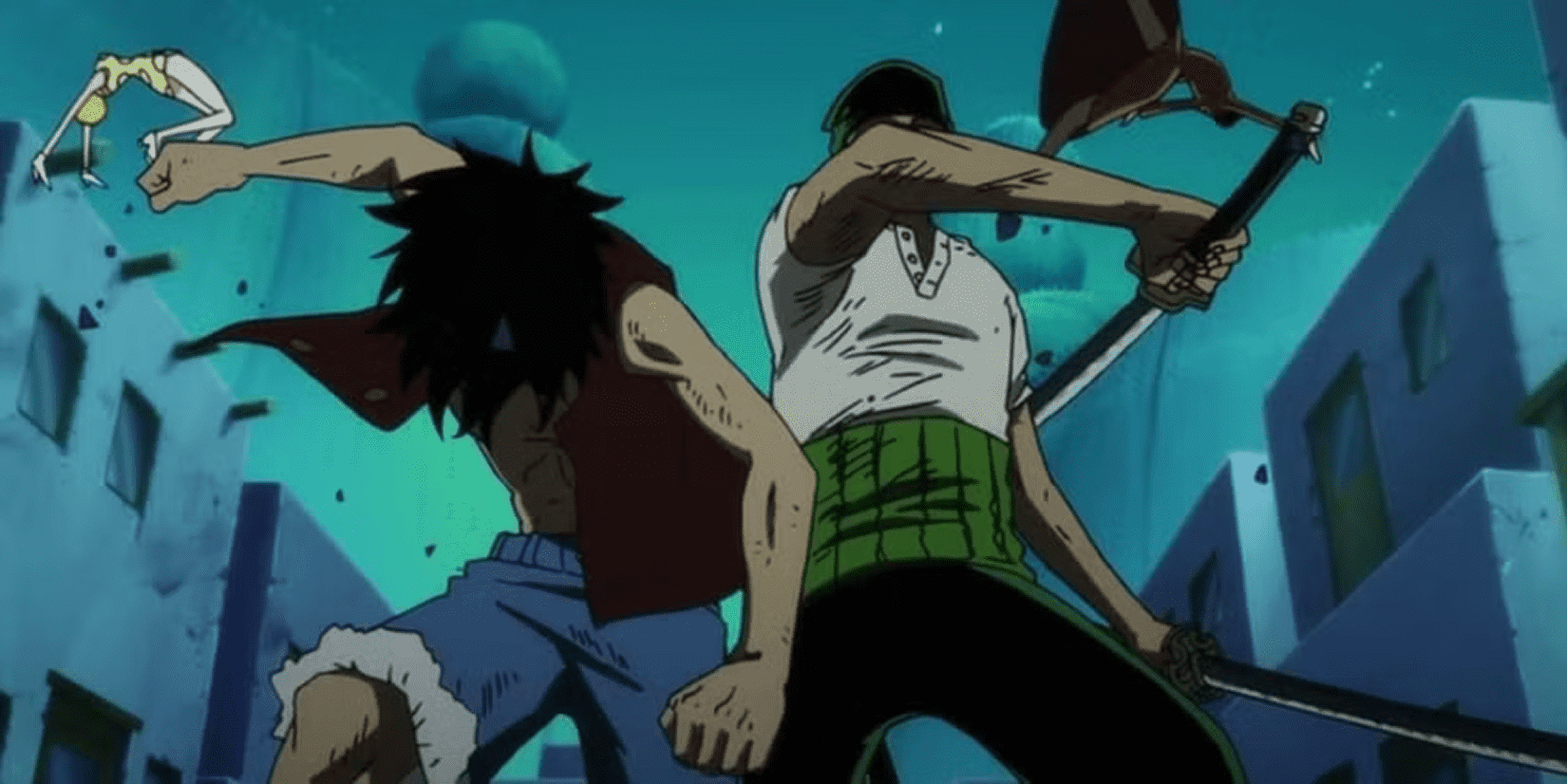
Whisky Peak is one of my favorite Zoro showcases in the whole series. The crew passes out drunk at a welcome party, the town turns into Baroque Works, and Zoro — already three sake bottles in — just goes to work. “You guys really are bad at parties.” A hundred professional bounty hunters and Zoro cuts through them like he’s stretching.
The fight that lands hardest, though, is right after: Luffy and Zoro fighting each other in the rain while Mr. 5 and Miss Valentine literally walk past them and they don’t notice. That sequence is the cleanest character beat for both of them. Luffy doesn’t get why Zoro cut people he was being friendly with. Zoro doesn’t get why Luffy didn’t ask first. Neither of them care about the actual villains in the scene. They fight, they figure it out, they move on. That’s the whole crew dynamic in three minutes.
Little Garden and the giants
Dorry and Brogy is Oda swinging for the fence. Two Elbaf warriors stranded on a prehistoric island, fighting the same duel once a day for a hundred years because neither remembers what started it — they just know the duel matters, and they trust each other enough to die finishing it. The volcano keeps time. Mr. 3’s wax trap tries to cheat the duel and gets justice done to it.
This is the arc where I started telling people One Piece is a serious story.
First watch — 2026
These arcs are past where my original 2022 anime watch ever got to — I bailed at Baratie and switched to the live action. So Whisky Peak and Little Garden were both fresh to me in 2026, on Netflix, after I’d already finished Marineford and come back to fill in everything I’d skipped.
Watching them in that order is wild. I already knew Vivi. I already knew what Alabasta costs her. So every scene of her on Whisky Peak’s rooftop trying to hold her cover read as a debt being built up in real time, and Little Garden’s giants felt less like a side quest and more like Oda quietly tuning the scale of the world before he turned the dial all the way up.
This is also the first stretch where the anime felt fast to me. East Blue had that slow vibe I remembered from 2022. The Grand Line opens and everything tightens.
The manga — Volumes 12–14, early 2026
I read these in the front half of Box Set 2. The Whisky Peak fight reads even cleaner on the page — Oda’s spreads sell the “Zoro at the center of a sea of bodies” composition the way only manga can. And Laboon’s silhouette against the Red Line is one of the panels that stops you.
The Grand Line is open. The giants are still fighting. Laboon is still waiting.
Chapter № VIII
Drum Island
Chopper, Dr. Hiriluk, and the cherry blossoms on the snow mountain.
What stuck with me
Drum Island is the first arc where One Piece made me cry. Three things stick with me: Chopper joining the crew, Luffy climbing the mountain with Nami and Sanji on his back, and Dr. Hiriluk’s cherry blossoms.
Hiriluk is the secret weapon of this arc. A quack doctor in a stovepipe hat who decides that the cure for a country isn’t medicine but belief — and then drinks his own poison, climbs to the castle, and dies smiling while his apprentice reindeer watches from the snow. Then Kureha keeps his last formula a secret for years, and the moment the country needs hope again, she fires it into the sky and the snow mountain turns pink. That’s not a flashback. That’s a doctor’s note.

The climb
The mountain climb is the cleanest image of Luffy’s whole character. Nami has a fever that’s going to kill her, Sanji has a broken back from Mr. 3, and Drum’s castle is at the top of a frozen cliff. Luffy doesn’t strategize. He bites his teeth into the cliff, carries them both on his back, and climbs. Hours. No grand speech. No power-up. Just the captain physically refusing to let his crew die.
Every later Luffy moment that makes you tear up is downstream of this climb.
Chopper
Chopper joining the crew is where the Straw Hats become a family. Up until now, every recruit has been a fighter — Zoro, Nami, Usopp, Sanji are all people who could survive on their own. Chopper isn’t. Chopper is a kid who got called a monster by both humans and reindeer and learned to be a doctor because Hiriluk loved him. Luffy doesn’t recruit him so much as adopt him. “Of course you’re a monster. You’re also our doctor.”

First watch — 2026
Drum Island is past where my original 2022 anime watch ever made it. So this was first-time-ever on Netflix in 2026, coming back to fill in the arcs I’d skipped after finishing Marineford.
Watching it knowing where Chopper ends up — knowing how many times this crew will lose people they love — made the Hiriluk death scene almost unbearable in the best way. I knew One Piece was a serious story by Arlong Park. Drum Island confirmed that the show is also willing to be a quiet one.
The manga — early 2026
I read Drum Island in Box Set 2. On the page, the cherry blossom sequence is one of those panels Oda earns by doing everything else right first. You spend the whole arc on a freezing white mountain. Then a pink snowfall. The contrast is the catharsis.
The crew has a doctor. The mountain has its spring. Hiriluk’s flag still flies.
Chapter № IX
Alabasta
Crocodile, Vivi's tears, and the first arc that feels like a real war.
What stuck with me
Alabasta is the arc that proved One Piece could write a war. Up until now the stakes have been a village, a restaurant, a kingdom-in-miniature. Alabasta is a country — a starving country with a civil war rigged by a Warlord — and the crew has to fight through three Baroque Works officer pairs just to get to the man at the top. Four things stick with me: Crocodile, Vivi’s plea, Pell’s sacrifice, and “let’s meet again.”
Crocodile
Crocodile is the first villain who beats Luffy. Twice. Sand Logia, a hook full of poison, and a worldview — “this country was always going to fall, I just charged admission” — that doesn’t fold under Luffy’s usual fist-and-friendship pressure. The first loss in the casino is a shock. The second loss, drowning in the sand grave under Rainbase, is the show telling you that being the strongest in East Blue means nothing on the Grand Line.
The water trick — Luffy biting into a barrel of water to turn his rubber arm into a usable weapon against Sand — is one of the cleanest “Luffy thinks under pressure” beats in the series. He’s not smart. He’s resourceful when it matters. That distinction carries the rest of his fights.

“Please save my country”
Vivi’s plea on the deck of the Going Merry is the emotional engine of the arc. She has no power to demand anything from these pirates. She has nothing to offer them. She just asks. And Luffy says yes without thinking — and so does everyone else, because Luffy said it.
Every fight in Alabasta is downstream of that yes. The crew doesn’t beat Crocodile because they want to. They beat him because they promised a princess on a boat.
Pell
Pell flying the bomb into the sky is the moment Alabasta stopped being a regular arc to me. He doesn’t hesitate. He doesn’t make a speech. He’s a falcon-zoan who loves a country and a princess, and the bomb is going to kill a hundred thousand people, so he just goes up. Oda gives him an explosion the size of a sunrise and lets the city believe their savior is dead.
The fakeout where he survives is the most necessary fakeout in the series. Some things you can’t actually pay for in death.

“Let’s meet again”
The ending of Alabasta is the first goodbye that hurt. Vivi stands on the dock as Princess of her country — the role she was always going to return to — and the Going Merry sails out. She can’t go with them. They can’t stay.
So she lifts her left arm to the sky and shows them the X. And every Straw Hat lifts their left arm back, X on every wrist, without looking and without saying a word — because they’re pretending not to know her so the Marines won’t take her crown. The crew has five members now. Vivi is the sixth they didn’t keep.

First watch — 2026
Alabasta is past where my original 2022 anime watch ever made it. First time was 2026, on Netflix, after I’d already finished Marineford and come back.
Watching it after the rest of the series is wild. I knew Crocodile’s whole arc — the Warlord status, the prison turn, all of it — before I ever saw his hook. So Alabasta played for me as Crocodile’s peak rather than his introduction. Same with Vivi: I already knew she was the friend the crew never sees again. Every scene of her smiling on the Merry felt like a debt to a goodbye I’d already watched.
This is also the first arc where the anime length stopped bothering me. Alabasta earns every episode. The desert is supposed to be long.
The manga — early 2026
I read Alabasta across the back half of Box Set 2 and into Box Set 3. On the page, the Crocodile fights are tighter, and the X reveal at the end is one of those panels that pays off the entire box set in a single image.
This is the arc that turned One Piece from “a thing I’m watching” into “a thing I’m reading carefully.” Alabasta is where the series stops auditioning and starts being important.
Chapter № X
Jaya & Skypiea
Bellamy's laughter, Noland's bell, and a god who isn't one.
What stuck with me
Jaya and Skypiea is the run that locked in what kind of story One Piece actually is. Four things stick: Bellamy and Cricket and Noland’s bell, Robin’s first arc as a Straw Hat, Enel as the false god, and Luffy ringing the golden bell at the end.
Bellamy and the bell
Jaya is short but it’s the thesis. Bellamy laughs at Cricket’s dream — at the idea that Noland the Liar was telling the truth, that the gold city of Shandora actually existed, that dreams of impossible things are worth a grown man’s life. Luffy lets him laugh. Takes the punch. Doesn’t fight back, because Bellamy isn’t worth fighting back at. Then on the way out, on a Mock Town street, Luffy folds him in one hit.
The whole rest of the arc is the punchline to that scene. They go to a sky island that isn’t supposed to exist. They find the city that wasn’t supposed to be real. And Luffy rings the bell — the one Noland heard four hundred years ago and got executed for claiming was real — and Cricket, dying of pride down on the Blue Sea, hears it. The man who laughed at dreams loses to a kid who didn’t.
That’s One Piece. That’s the whole thing.

Enel
Enel is the cleanest “Logia + arrogance + plot armor disagreement” villain in the series. Lightning is supposed to be unbeatable. Mantra makes him untouchable. He’s spent the entire arc planning the genocide of an entire civilization, and he’s planning it casually — the way you’d plan a chore.
Then Luffy turns out to be rubber, and the whole god routine breaks in front of him. “Yahahaha” turning into actual fear on a Logia’s face is one of the best villain arcs in early One Piece. He doesn’t get a tragic backstory. He doesn’t get a redemption. He gets outclassed by a material property and his face has to do the work.
Robin
This is Robin’s first real arc as a Straw Hat and it’s where Oda quietly tells you she belongs. She’s the only crew member who knew sky islands could exist, the only one who reads the Poneglyphs, the only one who walks into the Shandian ruins like she’s been waiting four hundred years to read them. She doesn’t have a hero beat in this arc. She has proficiency beats — and proficiency is its own character development for someone who just stopped running.

First watch — 2026
Jaya and Skypiea are past where my 2022 anime watch ever got. First time was 2026, on Netflix, after Marineford.
Watching Skypiea knowing where the Poneglyph hunt eventually leads is different than watching it cold. You already know what Robin is reading for. You already know what the Void Century is. So the Shandora ruins don’t read as worldbuilding setup — they read as Robin getting her first real piece of the puzzle on screen, surrounded by people who don’t yet understand what she’s looking at.
And Bellamy at Mock Town hits harder when you’ve seen where Bellamy ends up. The laughing man becomes a guy with his own dream that gets laughed at later. Oda doesn’t waste a character.
The manga — early 2026
I read Skypiea across Box Set 3. On the page, the arc is much faster than the anime — the anime stretches the sky-island climb across a lot of episodes, while the manga rips through it. The bell sequence at the end lands harder in fewer panels.
The bell rings. Cricket hears it. The dream wasn’t a lie.
Chapter № XI
Davy Back Fight
Long Ring Long Land — Foxy, Aokiji, and the first whisper that the world is much bigger.
What stuck with me
Davy Back Fight is mostly a beach episode. Foxy the Silver Fox, the games, the donut race, Luffy’s afro — it’s filler-adjacent even in canon. Two things stick anyway: Aokiji’s debut, and the games themselves as a tone reset between Skypiea and Water 7.
The games
Honestly the games are fun. The donut race is fun. Groggy Ring is fun. Luffy and Foxy’s slap fight at the end is fun. After Skypiea — which is a dense, mythological, world-historical arc about gods and four-hundred-year-old genocides — Long Ring Long Land lets the crew take their hats off and play. Oda earns this kind of beach break after what Skypiea cost emotionally.
The thing the games actually do is reinforce that this crew loves each other. They lose Chopper to Foxy and immediately spend an entire round of games to get him back. They don’t strategize. They don’t weigh the cost. Of course they get him back. He’s theirs.

Aokiji
Then Aokiji walks in on a bicycle and the temperature of the show drops thirty degrees.
This is the first Admiral. Up to this point, Luffy has fought a Warlord (Crocodile) and lost twice before winning. Aokiji is above that tier. He freezes the ocean by touching it. He freezes Robin in one motion. The only reason any of the crew survives this scene is that Aokiji is a Marine who chose not to kill them today — and he tells them as much. “Lazy justice.” A man who would rather lie in a hammock than do his job, who can still kill the entire crew in five seconds if he stands up.
And the conversation with Robin is the part that lingers. He knows her. He knows what she is. He tells her plainly that the world isn’t going to stop chasing her, that the crew is going to find out who she is sooner or later, and that they probably aren’t strong enough to protect her when it happens. He’s wrong about the crew. He’s right about everything else.
The cold open for Water 7 starts here.

First watch — 2026
Davy Back Fight is past where my 2022 anime watch ever made it. First time was 2026, on Netflix, after Marineford.
Watching DBF after the rest of the series gives the Aokiji scene all of its weight. You already know what an Admiral is. You already know what Robin’s past is. You already know what comes next for her on the train. So the bicycle scene plays like a clock starting.
I won’t oversell the arc. The Foxy stuff is fun the first time and pretty skippable on rewatch. But the Aokiji scene is one of the most important conversations in the East Blue → Paradise stretch, and it’s hiding inside a beach episode. Classic Oda.
The manga — early 2026
I read DBF in Box Set 3 / 4. The games compress well on the page — Oda gets through them quickly, and the Aokiji scene at the end is even tighter than the anime. Aokiji’s whole introduction is a handful of panels, and it’s enough.
Fun arc. Quiet warning. The next stretch is going to hurt.
Chapter № XII
Water 7
Robin's secret, Usopp's duel, and the saddest shipwright in the world.
This page is yet unwritten.
Scrub the timeline to read a different chapter — or check back when this leg of the voyage has been recorded.
Chapter № XIII
Enies Lobby
I want to live! — and the Going Merry's final voyage.
This page is yet unwritten.
Scrub the timeline to read a different chapter — or check back when this leg of the voyage has been recorded.
Chapter № XIV
Thriller Bark
Brook joins the crew, and Zoro takes everything for his captain.
This page is yet unwritten.
Scrub the timeline to read a different chapter — or check back when this leg of the voyage has been recorded.
Chapter № XV
Sabaody Archipelago
The Eleven Supernovas, a Celestial Dragon, and a hand on every shoulder.
This page is yet unwritten.
Scrub the timeline to read a different chapter — or check back when this leg of the voyage has been recorded.
Chapter № XVI
Amazon Lily & Impel Down
Hancock's love, Bon Clay's sacrifice, and the worst prison in the world.
This page is yet unwritten.
Scrub the timeline to read a different chapter — or check back when this leg of the voyage has been recorded.
Chapter № XVII
Marineford
The Summit War. The arc that changed the world — and the show.
This page is yet unwritten.
Scrub the timeline to read a different chapter — or check back when this leg of the voyage has been recorded.